
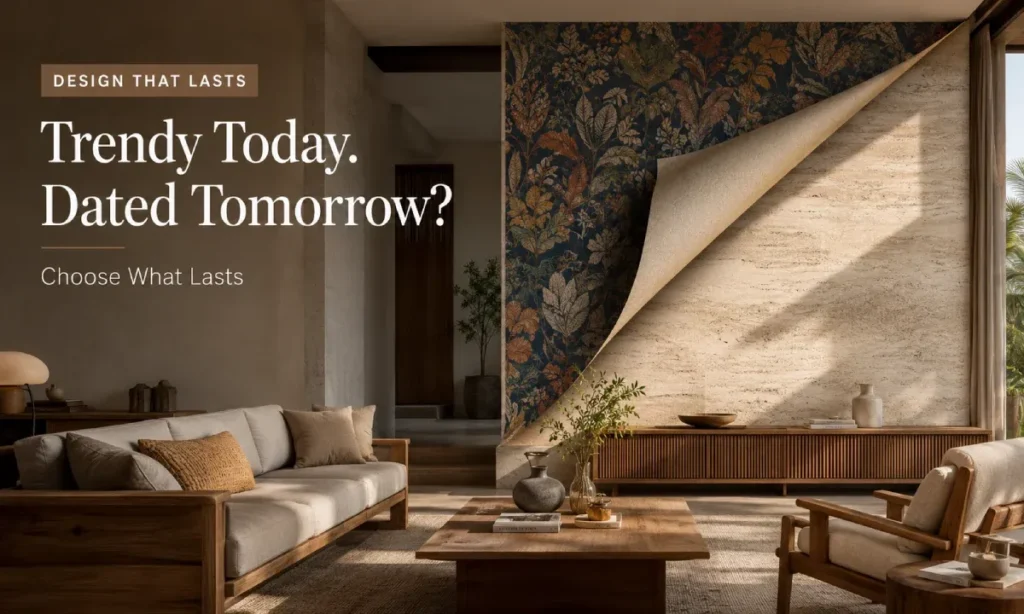
In 2020, dark accent walls were in every second home renovation in India. By 2023, most of those walls were repainted. The homeowners who chose them didn’t do anything wrong. They just paid for a colour with a 2 to 3 year shelf life, then paid again to remove it.
That’s the real cost of trend-driven design. Not that trends look bad. It’s that they expire, and expiring elements are expensive to replace.
What “timeless” actually means
Timeless design isn’t a style. It’s a set of choices that hold up regardless of what’s fashionable that year.
4 things make a design timeless:
Proportion. Rooms, windows, and furniture sized correctly for the space, so nothing looks cramped or oversized once trends change around it.
Material quality. Solid wood, natural stone, and good hardware age visibly better than laminate or veneer, even when both look similar on day 1.
Natural light. A well-lit room reads well in any decade. Lighting fixtures can change; the light itself is structural.
Neutral bones. Walls, flooring, and cabinetry in tones that don’t fight with whatever furniture or color scheme comes next.
None of this means a home has to look plain. It means the expensive, hard-to-change elements stay flexible enough to carry different looks over time.
Where trends are safe to use
Some parts of a home cost little to update, so using a trend there carries almost no risk.
Cushions, throws, and small decor items. Wall art. Table lamps and pendant lights, as long as the wiring and fixture points stay standard. Rugs. Even an accent wall, if it’s done in removable wallpaper or a paint finish you’re prepared to redo in 3 years.
These are the places to have fun with whatever’s popular right now. Swapping them out later costs a few thousand rupees, not a renovation budget.
Where trends become expensive mistakes
The problem shows up when a trend gets applied to something structural or built-in.
Flooring is the biggest one. A homeowner who chose a heavily patterned tile because it was trending in 2019 is now looking at re-tiling an entire home to sell it or simply to stop feeling tired of it. Kitchen cabinetry is another: bold colored cabinets or an unusual layout that was popular for a season locks in a look that’s costly to undo. Wall finishes like textured plaster or a specific stone cladding fall in the same category, along with any built-in furniture, since built-ins are, by definition, not easy to remove.
If a choice needs a contractor to reverse, it needs more thought than a Pinterest board gives it.
The Ahmedabad factor
Climate changes which materials actually last here, independent of style.
Ahmedabad’s heat and dust are hard on certain finishes. Light-colored natural stone, like Kota stone or a well-sealed marble, handles daily wear and heat better than some imported tile finishes that look striking in a showroom but show scratches and dulling within a couple of years. Teak and other local hardwoods perform well against humidity swings and are easier to source and repair locally than imported veneers. A design that photographs well on an international design account doesn’t automatically survive an Ahmedabad summer.
“We tell clients the same thing every time a trend comes up: ask what it costs to undo before you ask how it looks,” says Rajesh Sheth, Founder and Principal Architect at Designer’s Circle. “A home has to work in this city for 15, 20 years. That’s a different question than what works in a photograph.”
A quick test before you commit to anything
Before locking in a material, color, or layout, ask 3 questions:
1. Will I still want this in 5 years, or am I choosing it because it’s everywhere right now?
2. If I stop liking it, what does it cost to change: a few thousand rupees, or a full contractor job?
3. Does it actually perform well in Ahmedabad’s climate, or does it just look good in photos taken somewhere else?
If the answer to the second question is “a full contractor job” and the answer to the first is uncertain, that’s the signal to choose the timeless option instead.
The short version
Use trends where they’re cheap to change. Use timeless choices everywhere that’s expensive to redo. Get the two mixed up, and a home that looked current in year 1 starts looking stuck by year 4.
Frequently Asked Questions
1. What is timeless interior design?
Timeless design uses good proportion, quality materials, natural light, and neutral finishes so a home stays visually current without needing to follow seasonal trends.
2. Are trendy interiors bad for resale value?
Heavily trend-driven choices in fixed elements like flooring or cabinetry can hurt resale, since buyers often see them as dated or as a renovation cost they’ll have to take on themselves.
3. How often should I update my home’s interior?
Small, low-cost elements like decor and lighting can change every 2 to 3 years. Structural choices like flooring and cabinetry should be planned to last 10 to 15 years.